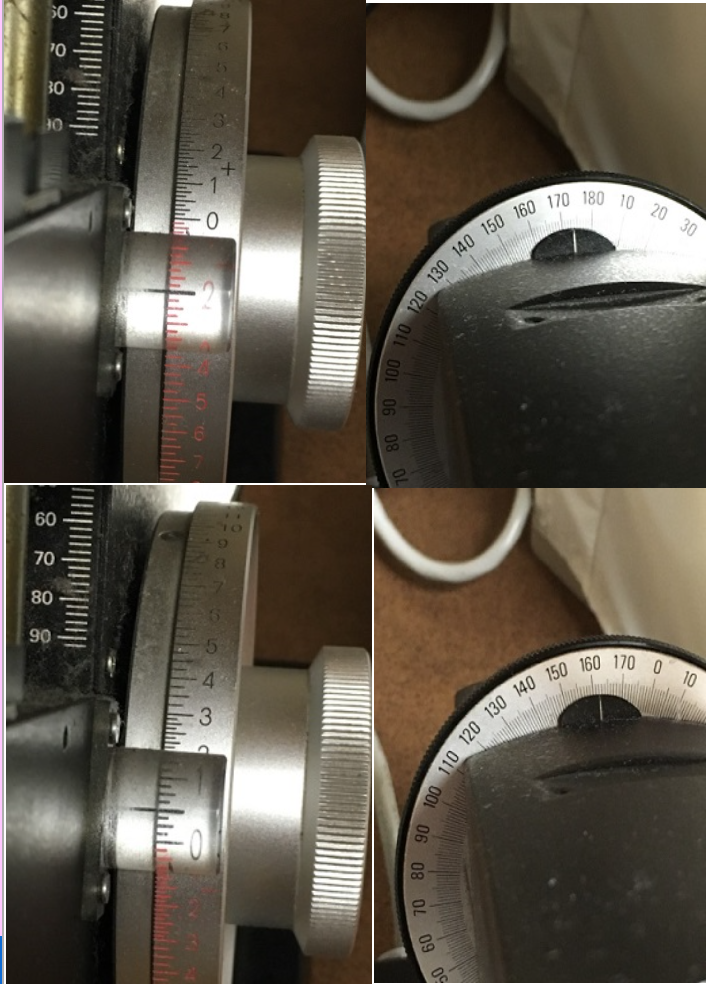
The add power in this pair of glasses is +2.50. The add is the difference between the near reading and the distance reading. You read the distance part of the lens first and write that power down. Then you read the near segment and subtract: near reading minus distance reading. Do the subtraction with the signs exactly as you wrote them, and keep that order every time. The add is always recorded as a plus number.
Work through a bifocal in a fixed order. First read the distance part at the top of the lens and write down the sphere, the cylinder, and the axis. Then move the lens stage so the near segment sits in front of the lensmeter opening. Refocus and read again. Always read the same type of line in both places. In plus cylinder technique you use the triple lines. In minus cylinder technique you use the single lines. Mixing the two gives a wrong add. The textbook gives a worked example: a distance power of -1.00 with a near reading of +1.00 is an add of +2.00. Remember that the near segment is always more plus than the distance part. If your math gives a minus add, you subtracted in the wrong direction.
Carry one sentence into the exam room: near reading minus distance reading equals the add. If a bifocal is very strong, turn the glasses around and rest the front surface against the lens stop before you read the segment. Measuring a bifocal add accurately is part of the COA lensometry content area.
Incorrect Answers
- A. This value falls short of the true difference between the two readings. The add is the whole difference between the near and distance powers, not part of it.
- B. This value is half a diopter short of the true difference. One common cause is reading the single lines in one part of the lens and the triple lines in the other.
- D. This value overshoots the true difference by half a diopter. It happens when the drum is turned past the point of sharpest focus.
Testing Pearls
- Add equals the near reading minus the distance reading, and it is always positive.
- Read the same set of lines, single or triple, in the distance part and in the segment.
- A trifocal is read in order: distance, intermediate, then near.
- For a high add, turn the glasses so the front surface rests on the lens stop.
- On a progressive lens, read the add as close to the bottom of the lens as possible.
References
- American Academy of Ophthalmology. Ophthalmic Medical Assisting: An Independent Study Course. Chapter 5, Optics and Refractive States of the Eye.
- American Academy of Ophthalmology. Ophthalmic Medical Assisting: An Independent Study Course. Chapter 12, Fundamentals of Practical Opticianry.